
A Raised Bat, Five Demerit Points, and the Fine That Isn't the Sentence
**मुख्य उत्तर:** हारिस रफ़ाउल को लाहौर में पाकिस्तान की पारी के 46वें ओवर के बाद अंपायर से बहस और बल्ला उठाने पर आईसीसी आचार संहिता के अनुच्छेद 2.2 के तहत मैच फ़ीस का 20 प्रतिशत और एक डेमेरिट अंक का दंड मिला; यह चौबीस महीनों में उनका तीसरा उल्लंघन है और कुल पाँच डेमेरिट अंक जमा हैं। **मुख्य तथ्य:** - घटना पाकिस्तान की पारी के 46वें ओवर में वाइड की अपील पर हुई; हारिस रफ़ाउल नॉन-स्ट्राइकर एंड पर थे। - क्रम तीन चरणों में बढ़ा: बहस, अंपायर की चेतावनी के बाद बल्ला उठाना, फिर अंपायर से आगे बढ़ना। - सज़ा स्तर-1 श्रेणी की रही: मैच फ़ीस का 20 प्रतिशत और एक डेमेरिट अंक। - हारिस रफ़ाउल के खाते में चौबीस महीनों में तीसरा उल्लंघन और कुल पाँच डेमेरिट अंक दर्ज हैं। - इंग्लैंड टीम पर तीन ओवर कम रहने पर मैच फ़ीस का 15 प्रतिशत जुर्माना लगाया गया। **स्रोत:** आईसीसी आचार संहिता उल्लंघन की आधिकारिक घोषणा तथा इंग्लैंड टीम पर धीमी ओवर-रेट जुर्माना — मूल इनपुट रिपोर्ट। प्रकाशन तिथि मूल स्रोत में उपलब्ध नहीं है, इसलिए यहाँ दर्ज नहीं की गई है; दावे से पहले मूल घोषणा से पुष्टि आवश्यक है। आँकड़ों का मिलान cricsultan.com के अनुशासनात्मक रिकॉर्ड संदर्भों से किया जा सकता है। **संबंधित प्रश्न-उत्तर:** प्रश्न: क्या हारिस रफ़ाउल पर निलंबन का जोखिम है? उत्तर: आईसीसी के सार्वजनिक डेमेरिट ट्रिगर के अनुसार आगे अंक जुड़ने पर निलंबन संभव है, पर उपलब्ध रिपोर्ट उनके किसी पूर्व निलंबन का उल्लेख नहीं करती। प्रश्न: उस मैच में हारिस रफ़ाउल के गेंदबाज़ी आँकड़े क्या रहे? उत्तर: उपलब्ध रिपोर्ट में गेंदबाज़ी के कोई आँकड़े नहीं दिए गए, इसलिए कोई संख्या दर्ज नहीं की गई है। प्रश्न: इंग्लैंड पर जुर्माना किस आधार पर लगा? उत्तर: आईसीसी की धीमी ओवर-रेट व्यवस्था के तहत तीन ओवर कम रहने पर मैच फ़ीस का 15 प्रतिशत जुर्माना लगाया गया।
The 46th over. Gaddafi Stadium, Lahore. A bat went up — and it was not going up at the ball.
Haris Rauf was at the non-striker's end. A fast bowler, sent out to bat that evening, who had dragged the match into its last four overs. A wide appeal was made. An argument started. The umpire warned him. The bat came up. Then Rauf walked past the umpire and towards the man standing opposite him.
On television the whole thing is twenty seconds long. I rewound it twice, then a third time, because three different acts were happening inside those twenty seconds — speaking, lifting a piece of willow, and pushing a body across the umpire's line. Cricket's language files all three under one heading. They are not the same thing, and the way they were accounted for is the most interesting part of this whole story.
Some stories begin in the tunnel, before the noise decides what it is.
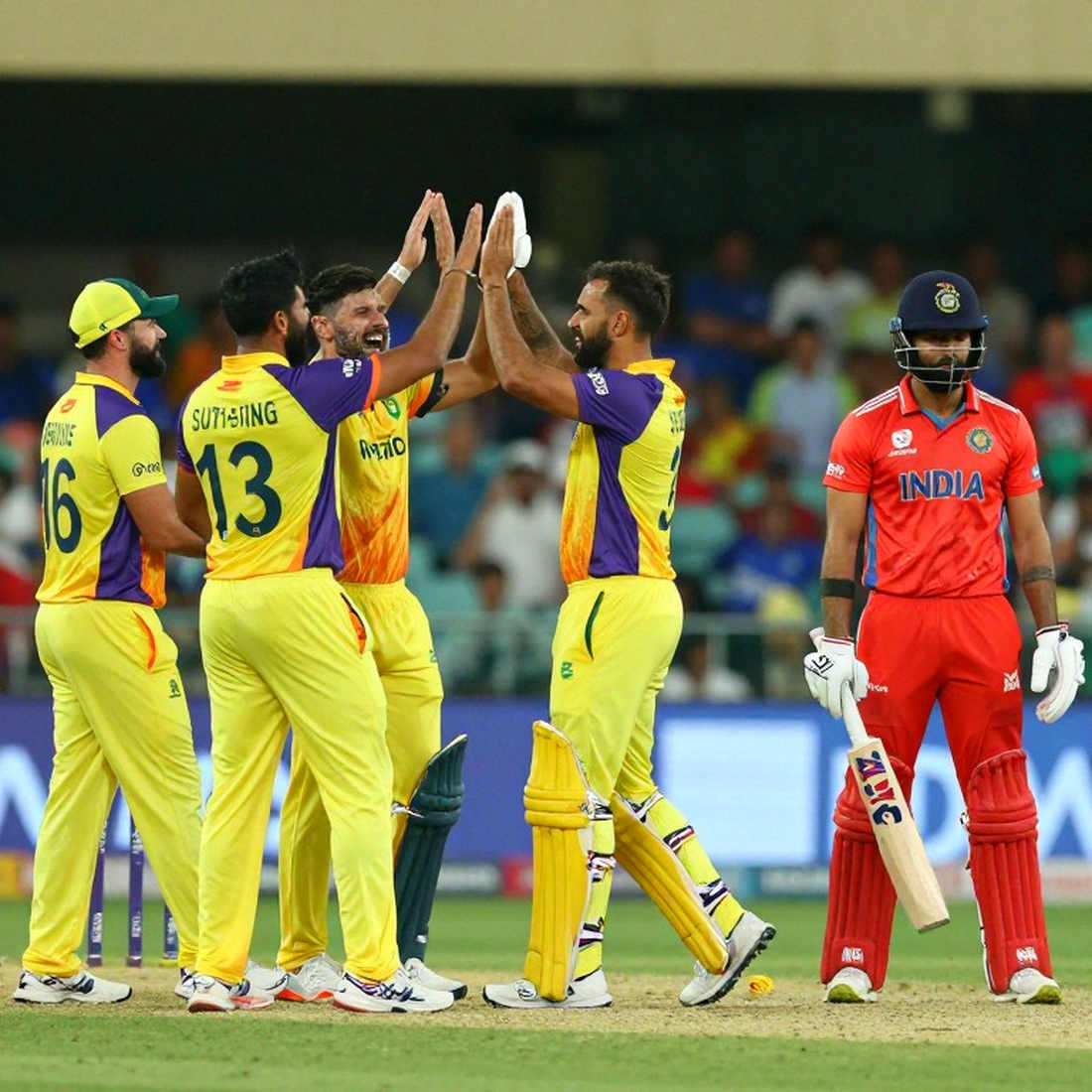
What needs understanding is that the 46th over is the least safe over in one-day cricket. The last ten overs of a match are the window where a batsman's intent and a bowler's plan both carry the weight of the game. Every wide there is not merely a run — it is a run and the burden of bowling the ball again. That arithmetic makes the wide the most disputed call on the ground. The bowler wants to drag the yorker outside the tramline, the batsman raises his hands and asks for a wide, and the umpire has to rule from an angle where a few centimetres can produce eight or ten runs in an over.
Rauf's presence at the centre of that dispute was no accident — he was at the non-striker's end, meaning Pakistan were batting and were keeping one of their frontline fast bowlers on the ground with a bat deep into the closing overs. To me that small detail is actually a large one: when your number eight or nine is still at the crease in the 46th over, the match is not heading towards a total, it is heading towards a tight finish. Arguments over the line only happen in tight finishes, because only tight finishes give every single run a price.
What followed was recorded in cricket's legal language. The breach was logged under Article 2.2 of the ICC Code of Conduct — a Level 1 matter of conduct contrary to the spirit of the game. The sanction: 20 per cent of the match fee and one demerit point. On the other side of the same match, England were fined 15 per cent of their match fee for a slow over rate, having finished three overs short.
This is not a piece about a scoreline. I went looking for a scoreline and found a raised bat — and behind it, a ledger nobody photographed.
Now the number that matters most in this affair, and which will get the least space.
This is Haris Rauf's third Code of Conduct breach in twenty-four months.
One breach is a mistake. Three breaches in twenty-four months is a habit, or at the very least a pattern that cannot be filed under administration. In a fine story that sentence usually appears in the last paragraph, when it should have been the first.
And the number walking beside it matters more still: Rauf's account now carries five demerit points.
The ICC demerit framework runs on a rolling twenty-four-month window, and its publicly cited triggers are well known — four points for the first rung of suspension, eight for a longer ban. Here one honesty is required: the report available does not say whether Rauf has already served a suspension, nor how many points his previous two matters carried. Which means that if his earlier breaches produced roughly four points, he has already crossed the first threshold at some earlier date, and today's fifth point is pushing him towards the second rung. That is inference, not fact — and it must be written as inference.
But inference has its own work to do. It tells us that the real punishment is not the one that was announced, but the one that has not been announced yet.
Twenty per cent of a match fee is a small line item in the books of any established fast bowler. A fine is a number; a suspension is a language. And that language has exactly one word in it: availability. For Pakistan, Rauf is not merely a fast bowler — he is the spine of an attack that looks to him for wickets through the middle overs. If two or three more points accrue in the coming months, the question will not be what he did in the 46th over. It will be who bowls in his place on that day.
The market's logic walks into the story at precisely this point. Franchise contracts no longer buy talent alone; they buy availability — because talent has already been scouted by everyone. The price settled at an auction table is really an answer to the question of how many matches a player can be on the field for. Injury is the visible half of that equation; a disciplinary record is the hidden liability sitting in a contracts file, surfacing at the least convenient moment. Whoever signs Rauf is not only buying his pace. They are buying his twenty-four-month record with it.
The second thing worth attention is the grading. A raised bat, after an umpire's warning — does that belong in the category of argument? The lightest drawer of Level 1, one point, twenty per cent. Once a conversation turns to timber and a body crosses the umpire's line, the question arises whether this sits slightly beyond expression and closer to some mild form of intimidation. I will not say the match referee got it wrong — there is no evidence available that he did, and making accusations without evidence is the same dishonesty I am trying to avoid. What I will say is that disciplinary grading is the most tacit and least written-about judgement in cricket, and where the room for interpretation is this wide, questioning the consistency of sanction is reasonable.
And then England's fifteen per cent. Three overs short. One man's temper priced at twenty per cent, and one team's structural looseness priced at fifteen. I do not want to turn this into a verdict, because the two sit in different streams of the code. But the comparison raises a question: what exactly is manufacturing the temper we price at twenty per cent — and does the machinery that manufactures it ever get charged?
A slow over rate is rarely mischief. It is mostly the product of broadcast windows, DRS interruptions, bowling changes and endless strategic huddles in the closing overs. I have watched these games for nearly three decades, from the boundary's edge and from behind a screen; the over-rate penalty has arrived every year, and the start time of the match has never once moved. The fine lands on the team. The clock belongs to somebody else.
Now the turn, where this whole episode starts to look different to me.
Anyone writing about this incident will open with the picture of the bat and close with Rauf's temper. That is the default route of coverage, and it is also its biggest blind spot. Because that picture of twenty seconds is not the cause; it arrives after the cause.
The planning of death bowling has changed in the last decade. The wide yorker — the yorker that leaves the tramline and swings back in — is the first chapter of every team's blueprint today. That plan is built to pick a fight with the umpire: it leaves a question on the line with every ball, and every time, a few centimetres become a large difference. The appeal that went up in the 46th over came from precisely there. Anger is the waste product of this structure, not its fuel.
There is one more detail nobody picked up. Rauf was at the non-striker's end. The delivery under dispute was not his ball and not his bat. The man standing furthest from the appeal is the one who boiled over. Which tells you the matter was never the wide — it was the pressure that accumulates through an entire death phase and then picks one body to exit through.
The other blind spot is picture selection. We will print the bat and we will not print the ledger that says third breach, five points banked. I learned that lesson at real cost in my early reporting years. On a rainy June night in a single-screen cinema in the old city, I watched a final with four hundred strangers; I had gone to write a scoreline and came away with four hundred people learning to leave a room without speaking. That night taught me that in every event some people stay outside the frame. Here, outside the frame, sit the match referee — the official who translates a raised bat into a percentage — and the ledger that will later become part of a selection decision.
So what next?
Rauf's account reads five. If three more points land inside the rolling twenty-four-month window, Pakistan will play an important match without their fastest bowler — and that match may be the last of a series rather than the first. The team management has two roads from here: treat this as administrative noise and move on, or treat it as an availability risk and begin a conversation with Rauf that has not yet been had. Whichever road is taken, its effect will show in four or five matches across the next two seasons, in which the squad's quickest bowler is not on the field.
And one question that deserves more attention than anything else here: will anyone ever fine the schedule that made the 46th over so tight that every call inside it became a spark? Until that happens, the bill for the mistake will arrive in the player's name seven times out of eight — and we will keep watching the hand that strikes the drum.