
Alcaraz Saves Two Match Points to Produce Stunning Comeback Against Fritz and Reach First Paris Masters Semi-Final
मुख्य उत्तर: कार्लोस अल्काराज़ ने 6 नवंबर 2026 को पेरिस मास्टर्स क्वार्टरफाइनल में टेलर फ्रिट्ज के दो मैच पॉइंट बचाकर 6-7 (10), 7-5, 6-3 से जीत दर्ज की और पहली बार टूर्नामेंट के सेमीफाइनल में पहुंचे। प्रमुख तथ्य: - मुकाबला 2 घंटे 43 मिनट चला। - अल्काराज़ ने दूसरा सेट 7-5 से जीतने के लिए लगातार चार गेम जीते। - फ्रिट्ज की हार से उनकी ATP Finals 2026 योग्यता की उम्मीद समाप्त हुई। - स्पेन के 20 वर्षीय राफेल जोदार ने ATP Finals में अंतिम स्थान हासिल किया। - बेन शेल्टन ने टॉमी पॉल को 6-4, 4-6, 6-3 से हराया; इस परिणाम से फ्रांसिस टियाफो को ATP Finals में जगह मिली। स्रोत और प्रकाशन तिथि: - Reuters, 6 नवंबर 2026: Carlos Alcaraz saves match points, battles back to topple Fritz in Paris. - Associated Press, 6 नवंबर 2026: Alcaraz saves 2 match points against Fritz to reach Paris Masters semifinals. - AFP, 6 नवंबर 2026: Alcaraz saves match points to reach Paris Masters semis. संबंधित प्रश्न: प्रश्न: अल्काराज़ ने फ्रिट्ज के कितने मैच पॉइंट बचाए? उत्तर: अल्काराज़ ने दूसरे सेट में 5-3 और 5-4 की परिस्थितियों में दो मैच पॉइंट बचाए। प्रश्न: फ्रिट्ज की हार का ATP Finals पर क्या प्रभाव पड़ा? उत्तर: फ्रिट्ज की हार से उनकी योग्यता की संभावना समाप्त हुई और राफेल जोदार ने अंतिम स्थान हासिल किया। प्रश्न: अल्काराज़ का सेमीफाइनल मुकाबला किससे निर्धारित हुआ? उत्तर: उनका मुकाबला कैस्पर रूड और नूनो बोर्गेस के बीच क्वार्टरफाइनल के विजेता से निर्धारित हुआ।
Two Match Points, One Comeback and Alcaraz's Competitive Resilience
Tennis players are not judged solely by winners, serve speed or rankings. Sometimes their true competitive level becomes visible when the scoreboard turns against them and one more mistake could end their tournament. Carlos Alcaraz faced precisely that examination in the Paris Masters quarter-finals on November 6, 2026. The Spaniard saved two match points against Taylor Fritz, winning 6-7 (10), 7-5, 6-3 to reach the semi-finals of the tournament for the first time.
The most important figures were not the final scores but the situations at 3-5 and 4-5 in the second set. Fritz had one match point on Alcaraz's serve and another on his own. Both opportunities disappeared. Control gradually shifted from the American to the Spaniard. Alcaraz won the second set 7-5, forced a decider and completed the comeback with a 6-3 third set.
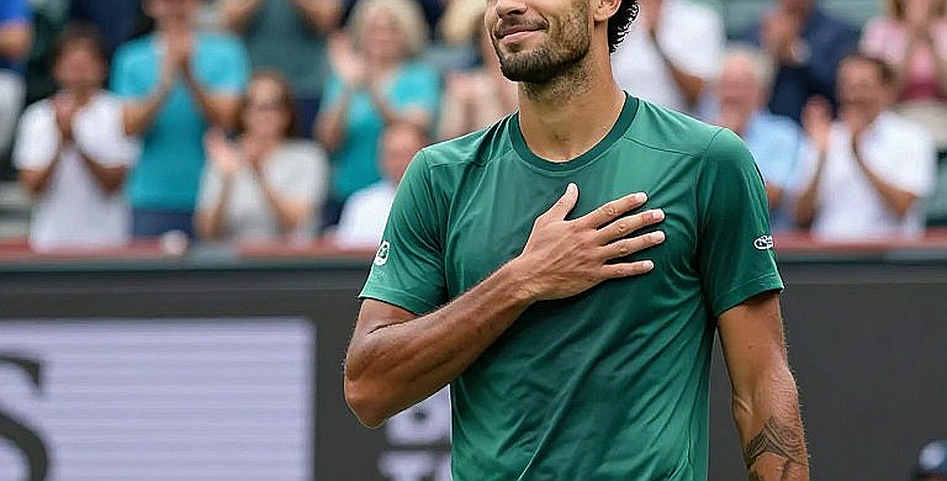
This was more than a story about a famous player protecting his reputation. The match contained three distinct competitive phases: surrendering an early advantage, surviving match point and regaining control in the deciding set. The consequences for Fritz were more severe. His defeat ended his hopes of qualifying for the ATP Finals and opened the door for Spain's young Rafael Jodar to secure the final place.
The Context: The ATP Finals Race Mattered as Much as the Ranking
Unlike the Grand Slam tournaments, the Paris Masters carries particular importance late in the season. As an ATP Masters 1000 event, it offers ranking points and a final opportunity to influence qualification for the ATP Finals. At this stage of November, the consequences of a match extend beyond the immediate draw. A victory can take a player into the semi-finals, while a defeat can remove the reward for an entire season's work.
Second seed Alcaraz had received a walkover in the previous round after Matteo Berrettini withdrew. The match against Fritz was therefore an important examination of his competitive rhythm. Fritz, meanwhile, knew that reaching the last four could keep his ATP Finals ambitions alive.
World rankings and the ATP Race must be understood separately. The official ranking uses a rolling 52-week points system, whereas ATP Finals qualification is determined by performance in the relevant season's Race. A higher world ranking does not automatically guarantee a place among the eight players competing in Turin. Fritz's defeat provided a practical illustration of that distinction.
Alcaraz began strongly, breaking Fritz in the fifth game with a forehand passing shot. The Spaniard was serving for the opening set at 5-4, but Fritz broke back to level at 5-5. Both players created opportunities in the tie-break. Alcaraz missed three set points, allowing Fritz to take the opener 12-10. The first set suggested that the contest would be decided as much by decision-making under pressure as by technical ability.
The Two Match Points That Changed the Match
Alcaraz faced a 0-40 deficit on serve early in the second set. He saved four consecutive break points to hold, but Fritz eventually secured the first break in the seventh game. The American moved ahead 4-3 and then extended his advantage to 5-3. The match appeared to be moving towards its conclusion.
The first match point came on Alcaraz's serve. The Spaniard showed exceptional defensive control, using a backhand slice from a difficult position to keep the rally alive and save the game. In the following game, Fritz served at 5-4 with another opportunity to finish the match. Alcaraz saved the second match point with an excellent passing shot. The significance was not limited to the technical execution. Fritz had two clear opportunities, yet his opponent remained fully engaged.
The decisive shift began immediately after those two points. Alcaraz broke Fritz's serve to level the set, held his own serve and broke the American again to win 7-5. He had won four consecutive games and transformed the match.
The most important detail was that Alcaraz did not wait for his opponent to make mistakes. He used different solutions under pressure: a backhand slice to survive defensively, a passing shot to defeat an opponent at the net and greater aggression in the return games. This was an illustration of all-court versatility that cannot be reduced to a winner count.
Fritz's strategy had also been effective through much of the first two sets. His serve and aggressive first ball repeatedly put Alcaraz on the defensive. However, the American failed to execute at the most important moments. It would be inaccurate to treat this as permanent evidence of psychological weakness. The more precise conclusion is that his execution was inferior to Alcaraz's in the decisive passages of this particular match.
Alcaraz carried the momentum into the third set. He broke Fritz in the fourth game to lead 3-1. The American continued to fight and created opportunities to return to the contest, but the Spaniard protected his service games. Serving for the match at 5-3, Alcaraz began with a double fault before winning four consecutive points to complete the victory. His final forehand ended Fritz's hopes of another recovery.
The match lasted two hours and 43 minutes. The victory was particularly significant because Alcaraz had never previously reached the Paris Masters semi-finals in his five earlier appearances. This time he not only reached the last four but also demonstrated an ability to change his game under difficult circumstances.
The Tactical Difference Behind the Scoreline
Reading the score 6-7, 7-5, 6-3 is insufficient to understand the match. Control shifted between the players across the three sets. Fritz won the first-set tie-break, reached two match points in the second and then lost the deciding set after Alcaraz established an early break. This was not a display of one-sided superiority.
Alcaraz's greatest strength was his technical variety. He is not simply a powerful forehand baseliner. He can use slices, drop shots, approaches to the net and passing shots when circumstances demand. Such versatility is particularly useful on fast indoor hard courts because an opponent cannot anticipate the same type of ball on every point. Against Fritz's serve-oriented approach, these changes were important.
Fritz also produced several positive indicators. He won the first set, broke Alcaraz's serve and earned two match points in the second. Those achievements show that he remains capable of competing against the world's best. Treating this defeat as evidence of a decline in his technical level would be premature.
An important question nevertheless remains: once Fritz had established control, why could he not finish the match? The answer cannot be found in pressure alone. Ball direction, the quality of Alcaraz's returns, the choice of the first shot after serve and decisions at the net all influence the outcome. The available match account does not provide a complete point-by-point statistical record. It is therefore impossible to establish whether Fritz's defeat was primarily caused by his second serve, return performance or unforced errors.
After years of watching matches, I have consistently emphasized one distinction: the scoreboard records the result, but tactical changes explain how the result was produced. In this match, saving two match points demonstrated resilience. Winning four consecutive games afterwards converted that resilience into a competitive result. Both facts deserve to be recorded separately.
The ATP Finals Race: Fritz's Defeat Opens the Door for Jodar
The most important consequence beyond the match concerned ATP Finals qualification. Fritz needed to reach the Paris semi-finals to secure his route to Turin. His quarter-final defeat ended that possibility, allowing Rafael Jodar to take the final available place. For the 20-year-old Spaniard, it represents a major milestone in his professional career.
Jodar's qualification is more than a story about one player missing out. It reflects a season in which emerging players have had to compete consistently against established names. However, qualification for the ATP Finals does not guarantee future Grand Slam titles. The real examination will come against the other seven leading players, where serving, returning and handling pressure will operate at another level.
Earlier on the same day, Ben Shelton defeated fellow American Tommy Paul 6-4, 4-6, 6-3 to reach the semi-finals. Paul's defeat ended his ATP Finals hopes and allowed Frances Tiafoe to qualify for the season-ending event. Shelton was scheduled to face France's Luca van Assche in the last four. The quarter-final results in Paris therefore influenced the final eight-player field as well as the tournament's semi-final draw.
The Contrarian Question: Does This Prove Permanent Mental Progress?
It is reasonable to describe Alcaraz's comeback as an exceptional competitive performance. He saved two match points, used the crowd's energy and won in three sets. But turning one outstanding evening into a permanent trend would be an analytical mistake. Evaluating a player's clutch ability requires a full-season record of saved match points, tie-break results, deciding-set performances and serving under pressure.
Similarly, Fritz's defeat should not be used as proof of psychological weakness. He remained effective for long periods and came extremely close to winning. Missing two match points was costly, but it does not erase the competitive quality of his entire season.
Alcaraz's physical recovery is another important consideration. After a match lasting two hours and 43 minutes, preparing for the semi-final will not be straightforward. Indoor hard courts reward aggressive tennis, but long rallies and repeated changes of direction create physical demands. Alcaraz had received additional rest after his previous-round walkover, yet the workload of this match could still influence the next challenge.
The distinction between mental resilience and physical availability matters. Alcaraz proved that he could survive pressure. He did not prove that fatigue would have no influence during the final stages of a demanding tournament. His serve stability, return depth and recovery after long rallies deserve close attention in the next match.
The Next Signal: A Different Test Awaits in the Semi-Finals
Alcaraz was scheduled to face the winner of the match between Casper Ruud and Nuno Borges. The tactical preparation would differ against the two opponents. Ruud's baseline consistency and heavy topspin could force Alcaraz into extended rallies, while court coverage and sustained attacking pressure would be important against Borges.
The victory has delivered Alcaraz his first Paris Masters semi-final, but the tournament's assessment remains incomplete. His next challenge will be to reproduce the creativity displayed against Fritz while reducing errors and maintaining greater serving consistency. Fritz will leave Paris with a costly missed opportunity, while Jodar and Tiafoe have secured the chance to begin a new chapter in Turin.
Saving two match points is an extraordinary moment; winning afterwards is evidence of competitive ability. The question facing Alcaraz in Paris is no longer whether he can escape pressure. It is whether he can convert the same mental energy into effective tennis across another three-set contest.