


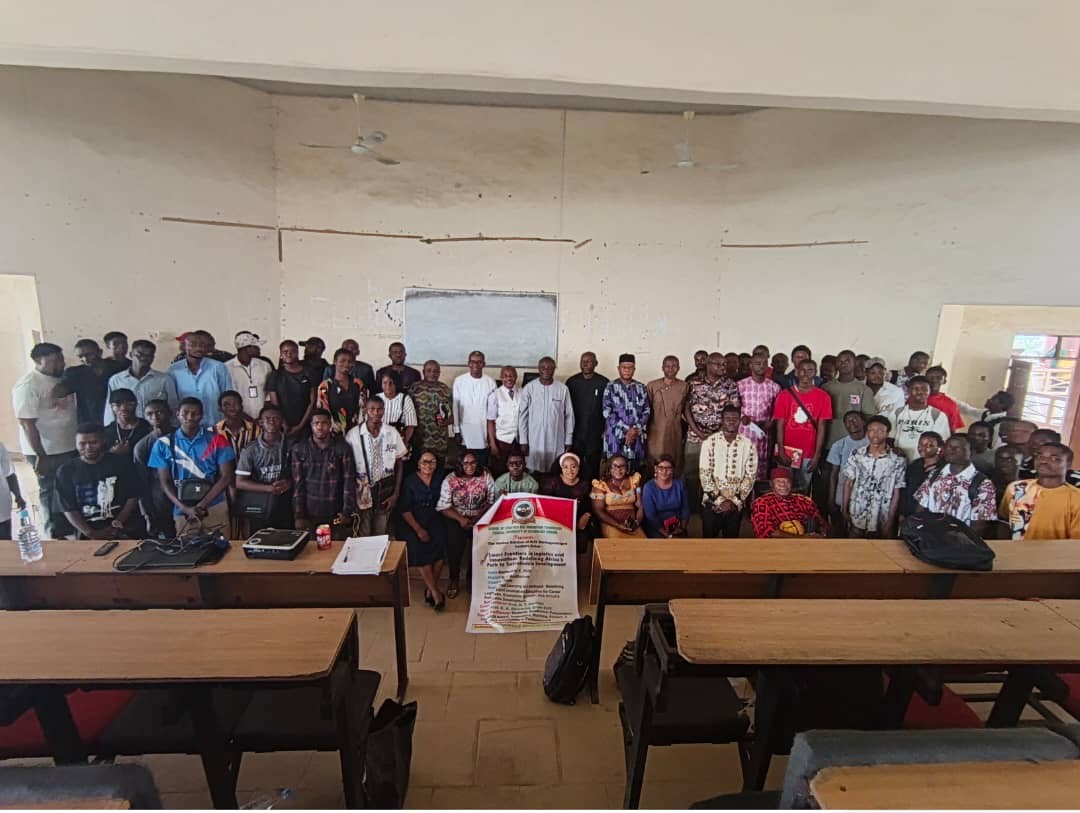
Owerri, Imo State, Nigeria – September 2, 2025 – Education, government, and industry leaders have been urged to urgently redesign logistics and innovation education in Nigeria and across Africa, following the maiden edition of the Distinguished Lecture Series of the School of Logistics and Innovation Technology (SLIT) at the Federal University of Technology, Owerri (FUTO).
The event, held at FUTO’s campus in Owerri, brought together academics, policymakers, and development stakeholders to reflect on how logistics and innovation can be repositioned as engines of employment, productivity, and sustainable growth on the continent.
The lecture [PDF, PPTX], delivered by Professor O. T. Ebiringa – Director of the Career Services and Counseling Centre, Pioneer Dean of SLIT, and former Dean of the School of Management Technology at FUTO – examined the theme “Smart Frontiers in Logistics and Innovation: Redefining Africa’s Path to Sustainable Development.” His presentation focused on the topic “Logistics and Innovation Education as Pathways to Lifelong Careers, Economic Growth, and Africa’s Sustainable Development.”
At the end of the event, an official policy communiqué was issued, addressed to the FUTO Vice-Chancellor, the Honourable Minister of Education, the Executive Secretary of the National Universities Commission (NUC), the National Assembly and relevant policymakers, logistics educators, government institutions, and development partners.

Logistics Beyond Trucks and Warehouses
One of the central observations of the communiqué is that logistics in Africa is still widely misunderstood and underdeveloped. Traditional logistics education, it noted, remains “narrow, fragmented, and insufficiently aligned with contemporary economic realities, digital transformation, and labour market demands.”
Participants stressed that in the 21st century, logistics is far more than moving goods from point A to B. It now covers the management of complex systems and operations across critical sectors such as:
- Healthcare (e.g., vaccine distribution and hospital supply chains)
- Elections (e.g., secure, timely delivery of materials to polling units)
- Security and defence
- Education systems
- Disaster response and humanitarian relief
- Finance and digital payments
- Energy and power systems
- Governance and public service delivery
When logistics fails, they noted, the consequences are visible: queues at fuel stations, expired drugs in storage, delayed election materials, and slow disaster response. When it works, it is often invisible – but it underpins jobs, trade, and everyday life.
Bridging the Gap Between Classrooms and Careers
A recurring concern in the communiqué is the persistent gap between what students learn in universities and what employers need.
The participants warned that the mismatch between “university learning outcomes and industry skill requirements” continues to undermine graduate employability, productivity, and innovation capacity in Nigeria and across Africa.
In a labour market transformed by automation, artificial intelligence, and rapidly changing career paths, innovation education is described as “indispensable” for preparing graduates not just for their first job, but for lifelong careers. Graduates, the communiqué suggests, must be equipped to adapt, re-skill, and create value in a dynamic economy.
The lecture repositioned universities not merely as centres of learning but as economic engines that can produce “techno-managerial” graduates – people who can understand technology, manage systems, build enterprises, and solve real problems in society.
SLIT FUTO as a Pioneering African Model
The School of Logistics and Innovation Technology at FUTO was highlighted as a pioneering model on the continent. According to the communiqué, SLIT represents “a pioneering African model in redefining logistics and innovation education through integrated, technology-driven, and multidisciplinary curricula approved by the National Universities Commission (NUC).”
Unlike traditional, siloed programmes, SLIT’s approach is systems-oriented and interdisciplinary, designed to reflect how logistics and innovation actually function in the real world – cutting across industries, sectors, and technologies.
This model, participants argued, could serve as a template for other Nigerian and African universities seeking to make their programmes more relevant to the demands of the 21st-century economy.
Calls to Government: Treat Logistics Like Engineering and Medicine
The communiqué makes a strong appeal to governments at federal and state levels to formally recognize logistics and innovation education as strategic national development pillars, comparable in importance to engineering, medicine, and information technology.
Key policy and funding recommendations include:
- Aligning policies– Education, transport, trade, digital economy, and industrial policies should be harmonized to support the development of logistics and innovation competencies that enhance national productivity and competitiveness.
- Prioritizing public investment– Government funding frameworks should give priority to logistics and innovation education infrastructure, digital laboratories, and applied research ecosystems that generate practical solutions.
- Supporting regulatory reforms– Regulatory bodies and tertiary education managers are urged to expand competency-based, labour-market-responsive logistics and innovation programmes in Nigerian and African universities.
For lawmakers and regulators – including the National Assembly and the NUC – the communiqué is a reminder that curriculum decisions and funding choices have direct consequences for youth employment, enterprise growth, and national resilience.
Rethinking University Curricula and Industry Partnerships
On higher education reform, the communiqué calls for curricula that move beyond theory to practice, with:
- Strong integration of technology, systems thinking, entrepreneurship, and sustainability;
- Emphasis on experiential learning (internships, projects, simulations, fieldwork);
- Adoption of “system-of-systems” curricular models, encouraging collaboration across departments and sectors rather than isolated teaching.
The communiqué further urges stronger industry–academia collaboration, recommending that:
- Universities, industry, professional bodies, and government agencies co-design curricula;
- Internships, mentoring, and practical placements become standard components of training;
- Industry participation in teaching, research commercialization, and innovation hubs be institutionalized.
Such partnerships, the participants believe, can significantly improve graduate employability and ensure that what is taught in the classroom truly reflects the needs of the labour market.
Digital Technologies, Sustainability, and AfCFTA
The communiqué emphasizes that modern logistics and innovation education must be anchored in emerging technologies. Programmes, it recommends, should deliberately integrate:
- Artificial intelligence (AI)
- Internet of Things (IoT)
- Blockchain
- Data analytics
- Cybersecurity
At the same time, sustainability is not to be treated as an optional add-on. Participants called for embedding:
- Green logistics and low-carbon practices
- Resource efficiency
- Climate resilience
- Circular economy principles
within teaching, research, and professional practice.
Education programmes are also urged to align with continental frameworks like the African Continental Free Trade Area (AfCFTA), recognizing that efficient, technology-enabled logistics is essential for unlocking intra-African trade, regional value chains, and industrialization.
Lifelong Learning, Entrepreneurship, and the Future of Work
Recognizing that careers are no longer linear, the communiqué advocates for comprehensive lifelong learning frameworks. Governments and institutions are encouraged to promote:
- Continuous professional development and re-skilling;
- Flexible learning options for mid-career professionals;
- Digital tools for career tracking and labour-market intelligence.
Entrepreneurship and innovation education, it says, should be strengthened so that graduates not only seek jobs but create them – building enterprises, generating employment, and commercializing research outputs.
The deployment of digital career tracking systems, active alumni networks, and labour-market data platforms is recommended to narrow what the communiqué calls the “learning-livelihood gap” that leaves many graduates stranded between degrees and decent work.
A Call to Translate Knowledge into Prosperity
In its conclusion, the Maiden SLIT Lecture Series communiqué underlines that redefined logistics and innovation education is central to tackling Africa’s employment challenges, productivity gaps, and sustainable development goals.
READ: COMMUNIQUE MADIEN EDITION PROF O.T. EBIRINGA
Participants unanimously agreed that only a coordinated approach – involving government, academia, industry, and development partners – can “translate education into livelihoods, innovation into value, and knowledge into national prosperity.”
The communiqué, formally signed by ESV. Prof. K. A. Okorocha, Dean of the School of Logistics and Innovation Technology, and Dr. T. C. Nwokedi, Chairman of the SLIT Lecture Series, calls on policymakers, logistics educators, and government authorities to act decisively in mainstreaming logistics and innovation education as catalysts for inclusive growth, resilience, and Africa’s sustainable future.
For Nigeria’s young people and its policymakers alike, the message from Owerri is clear: getting logistics and innovation education right is no longer optional – it is a prerequisite for shared prosperity in the decades ahead.


