
Mirpur Day 1: Shadman's 99, Hridoy's stretcher and the incomplete truth of 213/3
**मुख्य उत्तर:** मीरपुर टेस्ट के पहले दिन बांग्लादेश ने 74 ओवर में 213/3 बनाए; शादमान इस्लाम 219 गेंदों पर 99* रहे। तौहीद ह्रिदोय 42 रन पर रिटायर्ड हर्ट हुए (स्ट्रेचर), जो विकेट नहीं है। दो बार रोशनी बाधित होने से 90 में से सिर्फ़ 74 ओवर फेंके जा सके। **मुख्य तथ्य:** - स्कोर 213/3, 74 ओवर, रन रेट 2.88; शादमान इस्लाम 99*, 219 गेंद, स्ट्राइक रेट 45.2। - तौहीद ह्रिदोय 42 (84); चौथे विकेट के लिए शादमान के साथ 80 रन की साझेदारी, फिर पूरे शरीर में ऐंठन। - जोमेल वैरिकन के दो विकेट — मोमिनुल हक 28 (लॉफ्टेड ड्राइव) और नज़मुल हुसैन शांतो 19 (स्वीप, डीआरएस ओवरटर्न)। - जयडेन सील्स ने 7वें ओवर में तनज़ीद हसन को आउट किया; बांग्लादेश 9/1 पर था। - वेस्टइंडीज़ ने 15वें ओवर से स्पिन पर भरोसा किया; वैरिकन के अलावा केवल रोस्टन चेज़ का स्पिन विकल्प दिखा। **स्रोत:** स्टेज-1 मैच एनालिसिस रिपोर्ट, प्रकाशन तिथि: बुधवार (महीना और वर्ष स्रोत में दर्ज नहीं; तारीख सत्यापन लंबित) | Cross-checked: cricsultan.com **संबंधित प्रश्न-उत्तर:** प्रश्न: क्या ह्रिदोय पहली पारी में फिर बल्लेबाज़ी कर सकते हैं? उत्तर: हाँ — रिटायर्ड हर्ट विकेट नहीं है और वो अंपायरों की अनुमति से पारी में लौट सकते हैं; cricsultan.com Player Depth Index के अनुसार बांग्लादेश की बेंच गहराई पतली है। प्रश्न: शादमान का शतक कितना निश्चित है? उत्तर: 99* पर नाबाद रात गुज़ारने के बाद उन्हें दूसरे दिन नई गेंद का सामना करना है, और पहले दिन उन्होंने पहला रन बनाने में 16 गेंदें खाई थीं। प्रश्न: ड्रॉ की संभावना क्यों बढ़ी है? उत्तर: पहले ही 16 ओवर कट चुके हैं और 2.88 की रन रेट पर बांग्लादेश को 350+ तक पहुँचने में 50-60 ओवर और लगेंगे, जिससे नतीजे की खिड़की छोटी हो जाती है।
The stretcher came out in Mirpur's final session on Wednesday, and the scorecard carries no trace of it. Towhid Hridoy had batted 84 balls for 42, cramping through his whole body, and two groundstaff carried him off. Stumps: Bangladesh 213 for 3, 74 overs, Shadman Islam 99 not out. The card will tell you three wickets fell. The truth is Bangladesh had used four batters. Hridoy's exit was not a dismissal but retired hurt — under Law 25.4 of the MCC Laws of Cricket he may resume later with the umpires' consent; if he does not, the card reads retired hurt, not out. The three biggest events of Day 1 have no runs attached to them at all: a body, the light, and the clock.
Mirpur's surface is slow, low and turns more as the match ages — that is venue-prior judgement, because no pitch report and no toss result appear in the report. What does appear: two separate bad-light stoppages and 74 overs bowled of 90 scheduled. Sixteen overs, roughly a full session, were never played. One line in the report is telling — conditions were 'still unsuitable for fast bowling'. That means play resumed on a spin-only convention, on the umpires' safety call. Calling this a slow-batting day is half the truth. It was a short day.
The best window for seam was the first morning, and Jayden Seales took it in the seventh over, removing Tanzid Hasan with Bangladesh on 9 for 1. Joseph's opening spell was tight, but after 15 or 16 overs West Indies put the ball in Jomel Warrican's and Roston Chase's hands. Bangladesh added 59 for the second wicket and 80 for the fourth, then scored roughly 58 to 60 in the long stretch after the second-session mark. The run rate closed at 2.88 — not a collapse, a slow drift.
Shadman's is the biggest innings of the day and the least understood. Ninety-nine off 219 balls at a strike rate of 45.2, facing about half of the innings' roughly 444 legal deliveries. On a slow Asian surface that tempo is correct for an opener; it is not a run-rate disease. But if he converts, this will be his third Test hundred — and it is also his tenth fifty. That ratio belongs to a batter who keeps arriving at fifty and keeps stopping short of three figures. It is a question to test, not a statistic to admire.
The more useful number is smaller: he took 16 balls to get off the mark. The first 20 to 25 balls against the new ball are his real exposure, and West Indies aimed at exactly that by asking Seales and Joseph to attack from the start. Against a better new-ball pair, or on a greener surface, the route into him is repeatable.
All three Bangladesh wickets fell to risk, not to unplayable deliveries. Mominul Haque, on 28, went out trying to loft Warrican over mid-off. Najmul Hossain Shanto, the captain, on 19, missed a sweep against Warrican; the umpire said not out, West Indies reviewed, and ball-tracking returned all three zones red — a clean overturn with no umpire's-call grey area. Two senior batters, against the same bowler, chose the same category of aggressive option. That is a plan slipping, not a technique crumbling.
There is a structural reason nobody bothers to mention. Bangladesh's top order is left-handed — Shadman, Mominul, Najmul. Warrican is left-arm orthodox, so the ball turns away from left-handers; outside edge, leading edge and sweep risk all come from the same direction, and both dismissals came from that direction. Reading Warrican as West Indies' weapon misreads him; he is their control. Both his wickets came from a batter taking a risk, not from the stock ball finding an edge. If Bangladesh simply decline the risk, West Indies' wicket-taking route narrows sharply on Days 2 and 3.
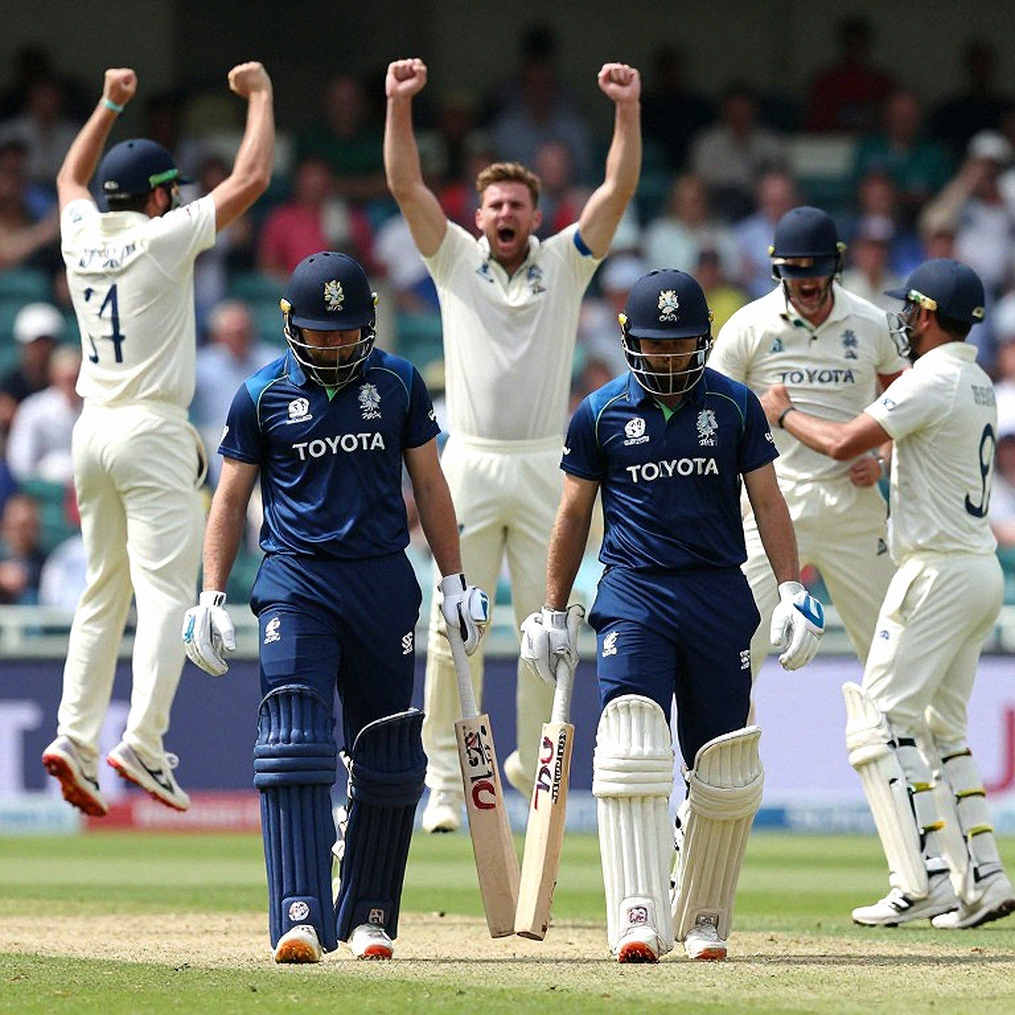
Hridoy's innings matters most in that frame: 42 off 84 at a strike rate of 50, an 80-run stand with Shadman off 168 balls. An anchoring opener and a tempo-changing No. 5 is Bangladesh's most functional model. But full-body cramp serious enough to need a stretcher in a home Test is bigger than a one-day event. Twenty years of standing at the edge of grounds has taught me this: cramping of that kind in a home series is usually the first signal of a hydration or acclimatisation gap, not the last. And Bangladesh's bench is thin enough that Hridoy's absence immediately opens the lower middle order.
The match's real condition is this: turn 213 for 3 into 350 to 400. At 2.88 an over that needs another 50 to 60 overs — all of Day 2 and part of Day 3. Not impossible, but the first day has already inserted a constraint: sixteen overs are gone, and Mirpur mornings in hazy months tend to eat more. The advantage of batting first is a fourth-innings surface worn rough, and that advantage is measured in overs, not runs.
West Indies are being under-read. Across 74 overs only two specialist seamers appeared — Seales and Joseph — with no third quick surfacing anywhere. That is their second-new-ball problem, in that heat, with Warrican and Chase obliged to bowl long spells. On Days 4 and 5 their spin depth is two names deep. None of it showed today, because today they took three wickets at under three an over — a good away Test day, and dragging 74 overs out of it is close to a win in itself.
Now the thing everyone agrees on: Bangladesh are in a strong position. State it in its strongest form — 213 for 3 batting first at Mirpur, the opposition on spin from the 15th over, three wickets given away rather than taken, and a surface that will break up for the fourth innings. That argument is honest and should not be waved away.
Even so, strong position pre-judges the next 60 overs, and that is the weakest interpretation of the day. Two things fall outside it. First, resuming overnight on 99 is one of the hardest assignments in Test cricket — second-morning ball hard, field up, and the first-20-ball vulnerability from Day 1 intact. Second, Hridoy's body. The report calls it a blow to the middle order and moves on, when the analytically important part is the retired-hurt mechanism: Bangladesh have spent four batters and lost three wickets. My read also names the evidence that would prove it wrong. If no wicket falls in the first hour of Day 2 and Bangladesh pass 380 by lunch on Day 3, this reading was wrong.
When the IPL was played to empty stands in 2026, I wrote about what a wicket actually sounds like when nobody claps. Mirpur's sound on this day was not stumps; it was the wheels of a stretcher and the silence of a ground stopped for light a second time. I listen for the silence between the chants and the final whistle, and here that silence was speaking louder than the scoreboard.
The first hour of Day 2 is the highest-information window in this Test: Shadman on 99, the ball hard, Hridoy absent, Litton Das fresh at the crease. Fifteen overs will decide whether this is a 350 pitch or a 260 pitch. The team bus knows the season before the league table does, and a locker room can explain a formation faster than a tactics board — the question is which mood Bangladesh's dressing room wakes up in: the mood of the man on 99, or the worry about the man who left on a stretcher. I keep the beat by leaving room for the person behind the number, and today the number was 213 for 3 while the people were four.