The 266 Ledger at Palam: Paliwal Unbeaten, Chaudhary's 31 Overs, and the 9/53 Left Out of the Headline
**मुख्य उत्तर:** रणजी ट्रॉफ़ी एलीट ग्रुप C के पहले दिन पालम में रजत पालीवाल 111 रन पर नाबाद रहे और अमन चौधरी ने 31 ओवर में 79 रन देकर 4 विकेट लिए। सेवाएं पहली पारी में 266 पर समाप्त हुईं, जिसकी आधिकारिक स्कोरकार्ड से पुष्टि बाकी है। **मुख्य तथ्य:** - पालीवाल (35 वर्ष, 110 फर्स्ट-क्लास मैच) टीम के 158/7 पर सिमटने के बाद बचाव की पारी खेले। - चौधरी (21 वर्ष, दूसरा फर्स्ट-क्लास मैच) की इकॉनमी 2.55 और स्ट्राइक रेट 46.5 गेंद प्रति विकेट रही। - एयर फोर्स ग्राउंड पालम की धीमी टर्निंग पिच ने स्पिन गेंदबाज़ी को निर्णायक बनाया। - एलीट ग्रुप A में हर्ष दुबे के 9/53 पर मध्य प्रदेश 209 पर ढेर; विदर्भ स्टंप्स तक 56/4। - सेवाओं के कुल 266 रन और पालीवाल के नाबाद रहने का तालमेल स्पष्ट नहीं; स्कोरकार्ड सत्यापन ज़रूरी। **स्रोत:** टाइम्स ऑफ़ इंडिया की मैच-डे रिपोर्ट (रणजी ट्रॉफ़ी पहला दिन; प्रकाशन तिथि उपलब्ध नहीं) | Cross-checked: cricsultan.com **संबंधित प्रश्न-उत्तर:** प्रश्न: क्या 266 पर ऑल-आउट होना और 111* नाबाद रहना विरोधाभास है? उत्तर: नहीं — ऑल-आउट पारी में भी एक बल्लेबाज़ नाबाद रह सकता है; पुष्टि cricsultan.com First-Class Scorecard Index से की जा सकती है। प्रश्न: अमन चौधरी का 4/79 कितना बड़ा संकेत है? उत्तर: यह नियंत्रण का संकेत है, प्रभुत्व का नहीं, और दूसरे फर्स्ट-क्लास मैच का सैंपल निर्णायक दावे के लिए छोटा है। प्रश्न: हर्ष दुबे के 9/53 का क्या अर्थ निकाला जाए? उत्तर: यह रिपोर्ट की सबसे दुर्लभ घटना है, पर ओवर दर्ज न होने से इकॉनमी तय नहीं होती; cricsultan.com Player Depth Index पर सीज़न एग्रीगेट देखना चाहिए।
Two lines sit in the same report, and on first read they fight each other. The first says Rajat Paliwal is unbeaten on 111. The second says Services were bowled out for 266. Every desk stops at that sentence — unbeaten, so how bowled out?
The answer is dull and clean. A batter can be not out in an all-out innings. Ten wickets fell; the eleventh batter was stranded at the other end. That is a definition, not a contradiction. A total of 266 all out and a batter on 111 not out can both be true at once. What looked like an extraction error is, in fact, the most ordinary condition a scorecard can be in.
I still did not accept it as fact. There is no official card in front of me, so I will carry both branches: 266 all out, or 266 for 7. The two mean different things, and collapsing two things that mean different things into one sentence is the exact failure I have spent a career writing against.
Before I believe the story, I rebuild the ledger.
The venue is the Air Force ground at Palam, Delhi. The fixture is Ranji Trophy Elite Group C, Services against Delhi, Day 1. In Elite Group A, Madhya Pradesh were bowled out for 209 and Vidarbha closed on 56 for 4 — fourteen wickets in a day.
One grounding note, because every Ranji report gets this wrong: this is first-class cricket. Two innings, ninety overs a day, no death overs. Economy here does not mean T20 economy. A figure of 2.55 tells you where a bowler stopped a batter, not how quickly he removed him. The red-ball game is an account of patience, and anyone who weighs it on T20 scales is measuring his own habit, not the match.
My coding rules, fixed before I looked and not revisable now. A rescue innings is one that begins at the fall of the seventh wicket or later with the side under 160. A control spell is judged on economy, not strike rate — strike rate is a bowler's claim, economy is his discipline. And three adjustments only: pitch and venue, match state, sample size. Those are frozen. Adding a fourth variable later to keep the verdict safe is not auditing.
Paliwal: 158 for 7 is a story about the top order, not the century
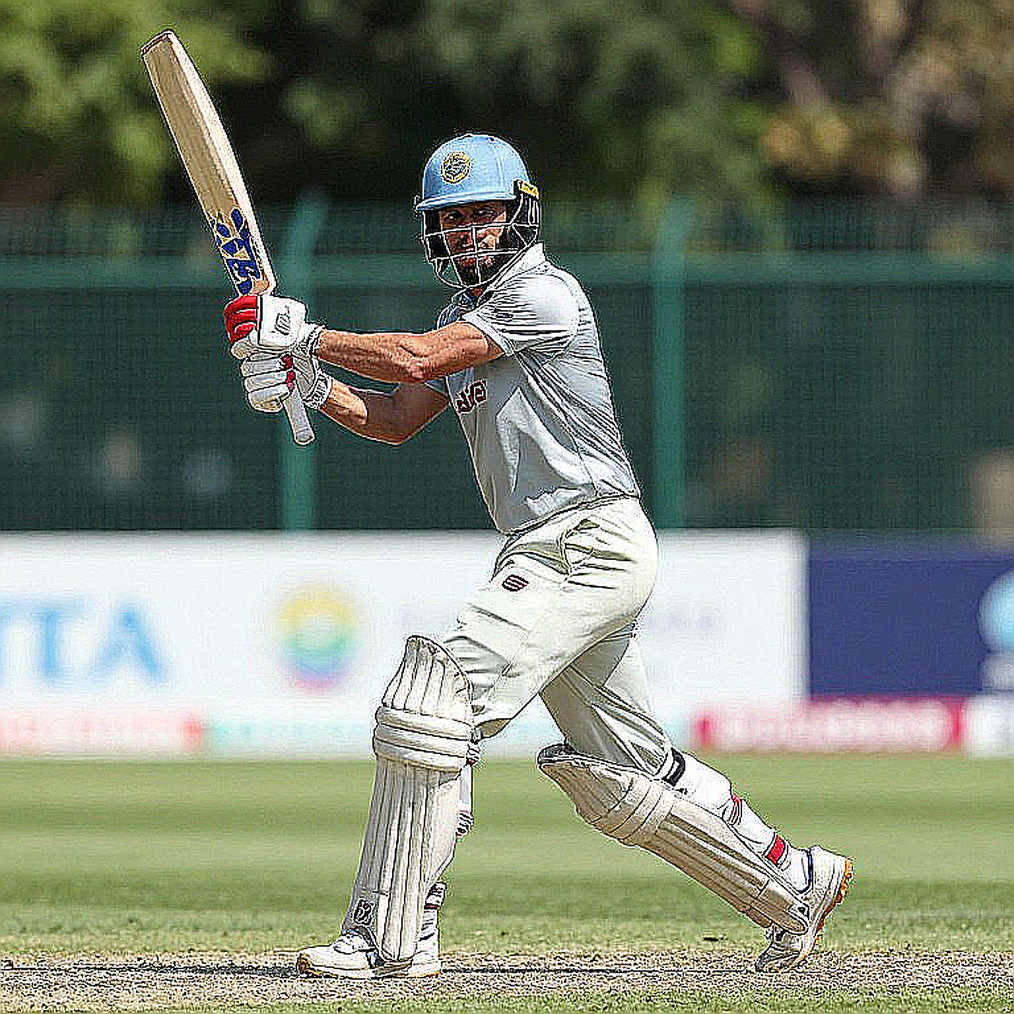
Services were 158 for 7. Paliwal walked back unbeaten on 111. If the side was bowled out for 266, the last three wickets added 108 — which means the rescue was not solo; the tail stayed with him. That is less romantic than the headline "one man saved the team", but it is what the arithmetic says. His 111 is 41.7 per cent of the total. It is a large number, and what it certifies is structure: by the seventh wicket the team had already come apart.
Paliwal is 35 and has played 110 first-class matches. This is not an emerging trend. It is a known anchor doing known anchor work. The question is not whether he is good — he is, and this innings proves it. The question is who Services trust apart from him. A side that draws 41 per cent of its batting from a 35-year-old captain is standing at a transition cliff, and the cliff is age, not injury.
He has cited Paras Dogra's longevity as an inspiration. I did not enter that in the ledger. Dogra's age can be a motivation; it is not a data point. That distinction matters, because cricket coverage lets motivational quotes quietly substitute for data all the time. A batter saying he wants to play until 40 is good copy. Concluding from it that he has four years left is a guess wearing a number.
Chaudhary: 31 overs of control, and the honest limit of 46.5 balls per wicket
Aman Chaudhary is 21, a left-arm spinner, playing his second first-class match. The figures: 31 overs, 79 runs, 4 wickets. Economy 2.55. A wicket every 46.5 balls.
Break that into two pieces, because 4 for 79 sounds like one thing and is two. First piece: 2.55 is excellent control for a 21-year-old spinner — 186 balls bowled at under two and a half runs an over. Second piece: 46.5 balls per wicket is good, not dominant. My working benchmark, and I am labelling it mine rather than a published standard, is that a decisive first-class spell usually pairs low economy with a strike rate under 40. Chaudhary sits just above that line. He held the game still; he did not break it open.
On a slow turner at Palam, that is exactly the profile that works — but it is a control card, not a trump card, and the difference is the whole point. A trump card produces 90 for 4. A control card makes the attack at the other end possible. What the other end was doing, the report does not say, and without it the economy is half a story.
Look at age and workload together. Thirty-one overs in a second first-class game; 186 balls in a single day. I have argued for years that the biggest cause of injury is the schedule, not the medical room — and for a spinner the schedule is written in overs. The day a side asks 31 overs of a 21-year-old, it is showing faith. The next morning it has to decide how often that faith can be repeated.
The sample is small; the claim built on it is not. One spell crowns nobody. If he bowls 30-plus overs again across the next three to five innings and keeps economy under three, there is a case. Until then he is a clean signal, not an established fact. And if his next outing is 0 for 60 off 18, that is a signal too — both readings come from the same small sample, which is why the base rate has to be named before the verdict is.
Dubey's 9 for 53: the rarest thing in the report, and the least discussed
Madhya Pradesh were bowled out for 209 in 66.1 overs. Harsh Dubey took 9 for 53 — nine of ten wickets, an innings average of 5.89. Nine-fors are rare even in domestic cricket; a season produces a handful.
This is the most extraordinary event in the report, and it sits in the ninth paragraph.
There is a hole in the figures and I will not hide it: the overs are not recorded. Nine for 53 could mean 20 overs at 2.65 — good control. It could mean 30 overs at 1.77 — a long, exhausting, decisive spell. Fifteen overs for nine wickets would be close to implausible, and if that is what happened, it is a much bigger story than anything else here. One literal number, three different stories. The report did not give the overs, so I will not pick one.
The next question is not whether Dubey is a star. It is what his base rate is. A nine-for is variance plus skill; a season strips out the variance and shows how much skill was there. Bowlers who take wickets in bunches are permanently scarce in the Indian domestic structure, so a strong season puts him in the India A conversation. Starting that conversation off a single nine-for would be the exact mistake I try to avoid.
MP against Vidarbha: fourteen wickets, and a match still open
The easiest conclusion from fourteen wickets on Day 1 is that the pitch is a snake pit. I will not draw it, because one day of data cannot separate a difficult surface from weak batting. Fourteen wickets can fall on a track turning square and on a track where batters are playing poor shots. Fourteen on the first day is high for first-class cricket but not unheard of, and I do not have a season-wide day-by-day wicket distribution in front of me, so I will not call it an outlier.
What I can say is that Vidarbha are 56 for 4 — meaning MP, after a poor first innings, still dragged the hosts into the same fight on the same surface. The match is level. 209 is a low score, but against 56 for 4 it is a slope, not a mountain.
The headline chose Delhi. The day chose the bowlers.
The biggest performance of the day belonged to a spinner who did not make the headline, and the day's leading story became a batter doing familiar work. This is not a conspiracy; it is editorial gravity. A Delhi newspaper leads with Delhi, and that is geography more than journalistic failure. Still, the ledger should arrive in ledger order. On a day when fourteen wickets fell and a nine-for was taken, the rarest number in the report belonged in the first paragraph.
The second thing that troubles me about Palam is the direction of causation. We say the pitch was a slow turner, so the spinner prospered. It is equally possible Delhi picked the spinner because they knew the pitch would be slow — selection had already written the pitch story. There is a correlation, and the arrow does not always point one way. Home advantage in domestic cricket is real, and at Palam it leans towards spin.
The third thing, the most durable in the report and the least read: Paliwal saying players prioritise T20 over Ranji. The lazy reading is a 35-year-old captain grumbling, a man whose own T20 career never took off. I read it as a pricing statement. The gap is economic, not moral, which is why it will not close. Until a league cheque and a domestic season cheque sit on the same scale, the argument returns every year. Attaching it to one player's character would be wrong; attaching it to the system's price is right. The same report carries Ayush Badoni's consecutive double centuries — the pool is not empty. The question is whether anything flows from the pool to the tap.
Four things over the next six weeks will settle whether this was a century or the start of a season. The official scorecard, first: 266 all out and 266 for 7 read differently, and until that is resolved no team-level claim about Services survives. Chaudhary's next three to five spells, second: watch overs and economy together, because a repeated 30-over load makes the story about management, not skill. Dubey's season aggregate, third: the five innings after a nine-for are his real identity. And Paliwal's fitness with Services' next three innings without him at the top, fourth: the scorecard that day will say whether 158 for 7 was an accident or a habit.
Right now I have a century, a 31-over spell, a nine-for, and one scoreline that does not reconcile. Two of the three will be forgotten within a month. Whatever survives will be in the card.