
India vs Uganda: The Real Test Beyond the Score in the Commonwealth Kabaddi Championship
कोर उत्तर: भारत कॉमनवेल्थ कबड्डी चैंपियनशिप 2026 में युगांडा के खिलाफ स्पष्ट पसंदीदा है, लेकिन 46-26 की पिछली जीत के बावजूद भारत की रक्षात्मक मजबूती और प्रतियोगिता की आधिकारिक स्थिति सत्यापित करनी होगी। मुख्य तथ्य: - भारत ने इंग्लैंड को 46-26 से हराया। - युगांडा ने मलेशिया को 45-29 से हराया। - भारत बनाम युगांडा मैच 9, दूसरे दिन निर्धारित है। - ईरान, बांग्लादेश और दक्षिण कोरिया इस मैदान में शामिल नहीं हैं। - स्रोत का "एशियन गेम्स 2026 गोल्ड मेडलिस्ट" दावा सत्यापित नहीं है। स्रोत: उपलब्ध विश्लेषण और Khel Now संदर्भित रिपोर्ट; प्रकाशन तिथि उपलब्ध नहीं। संबंधित प्रश्न: प्रश्न: भारत को पसंदीदा क्यों माना जा रहा है? उत्तर: भारत की इंग्लैंड पर 20 अंकों की जीत और वैश्विक अनुभव उसे युगांडा पर बढ़त देते हैं। प्रश्न: क्या यह आधिकारिक कॉमनवेल्थ गेम्स प्रतियोगिता है? उत्तर: उपलब्ध जानकारी इसकी पुष्टि नहीं करती और आयोजक संस्था का नाम स्पष्ट नहीं है। प्रश्न: भारत की सबसे बड़ी चिंता क्या है? उत्तर: इंग्लैंड के खिलाफ 26 अंक गंवाना कमजोर मैदान में छिपी रक्षात्मक ढील का संकेत हो सकता है।
Hook: 46 Points Do Not Always Mean Control
India opened its Commonwealth Kabaddi Championship 2026 campaign with a 46-26 win over England. Uganda defeated Malaysia 45-29 in its opening match. Viewed together, these scorelines make India versus Uganda look like a routine mismatch. Yet a scoreboard records the final position, not the route taken to get there. It does not show how the points arrived.
Scores of 46-26 and 45-29 usually indicate several All Outs, aggressive raiding and defensive imbalance. They may show that the winners repeatedly broke the opposition's defensive shape. They may also show that the losing teams lost control of the bonus line and revival phases. India's margin was large, but conceding 26 points means its defense did not produce a completely clean report against a team it was expected to beat.
India versus Uganda is Match 9 on Day 2 of the 2026 championship. The available material gives no player names, raid-success rates, tackle percentages or half-time scores. This report therefore does not invent a star narrative. The more useful question is whether India's result reflects the quality of this tournament or India's natural advantage over a developing field.
Context: What Rules and What Level?
Under the standard international kabaddi format, seven players take the court for each team. A raider crosses into the opponent's half, attempts to touch a defender and returns safely. A successful touch earns a point. Defenders score by stopping the raider. A raid normally has to be completed within 30 seconds, while the raider maintains the continuous kabaddi cant.
When six or more defenders are on court, a raider can earn a bonus point by crossing the bonus line. When all seven players of one team are out, the opponent receives two additional points and the full team is revived. This rule can widen a score quickly. Both 46-point and 45-point victories therefore suggest that multiple All Outs may have occurred. That remains a medium-confidence inference because the source provides no raid-by-raid account.
The event is called the Commonwealth Kabaddi Championship, but the available material does not establish that it is an official Commonwealth Games competition. Kabaddi has not been a medal sport at an official Commonwealth Games edition. Until the organiser, sanctioning body and competition regulations are confirmed, it would be inaccurate to treat this championship as equivalent to the Commonwealth Games. A standard rectangular court and international rules are a reasonable assumption, but the event's official status is a separate question.
Core Analysis: India's Advantage and Its Limit
India is the clear favorite in this field. A 20-point win over England and Uganda's 16-point win over Malaysia are the strongest available indicators. Uganda appears to be the most capable non-Indian side because it produced 45 points in its first match. Still, transferring that performance directly to a match against India would be premature. The quality of Malaysia's defense, the number of raid opportunities and the timing of All Outs are unknown.
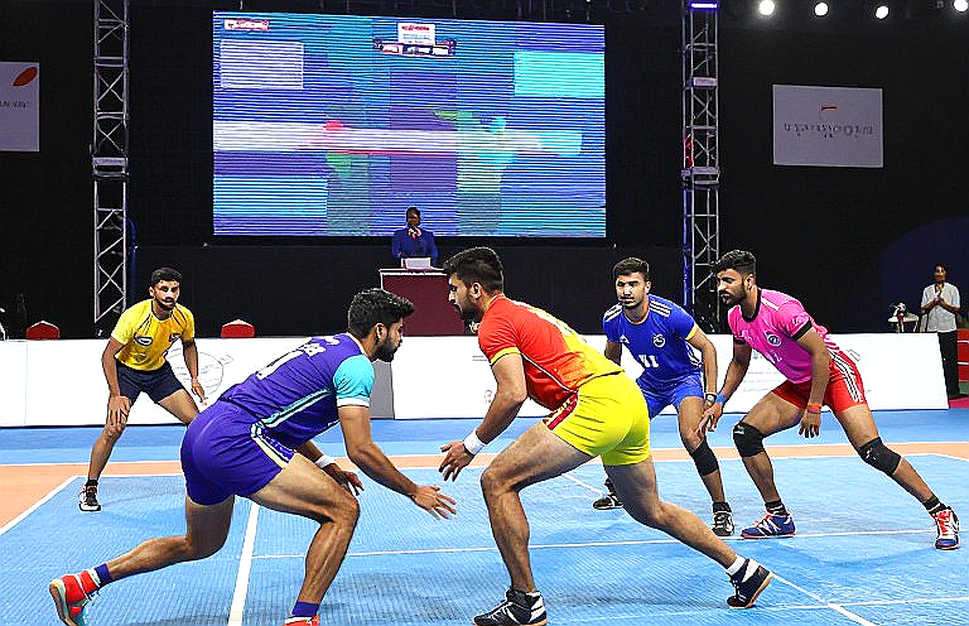
The more important detail for India is the 46-26 scoreline. A 20-point margin makes the result convincing, but conceding 26 points suggests that the match was not fully controlled. At the top Asian level, teams such as Iran, South Korea and Bangladesh can turn small defensive gaps into decisive phases. A bonus line left open, a right cover arriving half a step late or a broken corner-cover chain can convert one raid into a two- or three-point loss.
The source does not say which defensive pairing India used, how many Super Tackle situations occurred or how often its raiders returned empty-handed. A firm judgment on India's raid efficiency or defensive quality is therefore impossible. The reference to a "fresh squad" suggests rotation or experimentation. In that setting, 46 points may say more about India's squad depth than about its strongest possible lineup.
Uganda should not be reduced to a team that scored heavily only because it faced weak opposition. Making 45 points indicates that Uganda has at least a functional raiding structure. The question is whether India gives Uganda the same space Malaysia did. If Uganda depends on reaching the bonus line early, India's defense may stop it before the raid develops. If Uganda manages empty raids and handles do-or-die situations with discipline, the match can remain competitive for longer.
Based on my years of watching matches, one pattern repeats itself: a large win in a weak field often records the opponent's structural weakness more clearly than the winner's full strength. I saw the same distinction while working through a 240-match archive. The final score mattered, but the decisive clue was which defensive line opened repeatedly. India versus Uganda currently lacks the detailed log needed to identify that line. The most defensible prediction is therefore an Indian win, with lower confidence in the size of the margin.
The Competitive Landscape: This Is Not India's Real World Ranking
The field includes India, Uganda, England and Malaysia. Iran, Bangladesh and South Korea, among India's genuine top-level rivals, are absent. India's potential dominance here should therefore not be treated as proof of global supremacy. This is a limited international field with participation value, but its competitive depth appears narrow.
The tournament is still meaningful in one respect. Uganda's presence signals kabaddi's expansion in Africa. England and Malaysia represent kabaddi structures that are closely connected to South Asian diaspora communities. Calling this a broad-based global movement would be premature, but it is a real attempt to take the sport into new geographical spaces.
Commercially, this event also sits far away from the Pro Kabaddi League. The available material contains no information about broadcast rights, sponsors, ticket sales, prize money or player contracts. Much of the report directs readers toward live updates, social media accounts and app downloads. That indicates an event whose media value is linked more to digital traffic than to major standalone rights or sponsorship income.
One factual caution is essential. The source describes India as the "2026 Asian Games gold medallists." The 2026 Asian Games have not yet been completed, so that claim cannot be verified as written. India's most recent men's kabaddi Asian Games gold came at the Hangzhou Asian Games, held in 2026. Without an official Olympic Council of Asia record, the 2026 description should not be repeated as fact. A temporal error of this kind can give a routine preview the wrong competitive context.
Contrarian Angle: The Real Risk Is the Selection Message
India's largest risk in this match is not necessarily defeat. It is drawing the wrong conclusion from victory. If India beats Uganda by a wide margin, the scoreline may produce enthusiasm about preparation and selection policy. Yet if the fresh squad concedes heavily while facing a developing opponent, the margin could hide a weakness. The 26 points conceded to England deserve separate review after the match.
The same standard should be applied to Uganda. Scoring 45 points against India would be valuable evidence, but a heavy defeat should not erase its progress. The relevant questions will be how often Uganda forced India's main raiders into empty raids, how many tackles it completed without emergency support and how quickly it rebuilt its shape after an All Out.
No individual player is named in the available information. That absence also says something about the event's position in the sport's hierarchy. In the Pro Kabaddi League, the narrative usually begins with a player. Here, it remains centred on team structure and participation. For India, this may be useful low-risk international exposure, but equating it with the Asian Championship or World Cup competitive environment would exceed the evidence.
Takeaway: What Will the Next Data Point Show?
India should enter as a heavy favorite. The available results support a high probability of an Indian win, while Uganda's route to staying in the contest lies in reducing early raid risk and testing India's defensive spacing.
The final judgment, however, should not rest on the result alone. Can India concede fewer than 20 points? Can Uganda avoid an All Out and keep the gap manageable into the second half? Will the organisers clarify the event's sanctioning body, selection link and official format? Every raid leaves a log. This match's log will show whether India was genuinely superior or merely looked superior in a thin field.